 World War II
| Class | Fletcher Class Destroyer |
| Displacement: | 2050 tons |
| Length: | 376'6" |
| Beam: | 39'4" |
| Draft: | 17'9" |
| Speed: | 35 knots |
| Armament: | 5 - 5"/38, 2x5 21" torpedo tubes |
| 4 - 1.1 AA Battery, 4 - Duel 20 MM AA Battery | |
| Complement: | 329 |
| Power Plant : | High-pressure super-heated boilers |
| Geared turbines with twin screws, | |
| 60,000 H. P. | |
| Builder: | Federal Shipbuilding, Kearny NJ. |
| Name / Hull Number | U.S.S. McGowan DD 678 |
| Laid Down: | June 30, 1943 |
| Launched: | November 14, 1943 |
| Commissioned: | December 20, 1943 |
| Decommissioned: | April 30, 1946 |
| Recommissioned: | July 6, 1951 |
| FRAM 52 Conversion | |
| Armament | 3 - 5" 38, 3 - 3"50 Duel Mounts |
| Decommissioned: | November 30, 1960 |
| Transferred to Spanish Navy Dec 1, 1960 | |
| Stricken from US Navy listing | Oct 1, 1972 |
| Fate: | |
| Spanish Navy | |
| Commissioned | Dec 1, 1960 |
| Renamed | Jorge Juan D25 |
| Decommissioned | November 15, 1988 and broken up. |
World War II
I wish to thank Don Reeder Seaman First Class, who had the foresight to keep a journal of the ships movements on a day by day basis during the Second World War. While researching the activities of the different operations in the Pacific Theater of War, many of the records were inaccurate and provided conflicting dates and information. It is because of the journal of Don that I am able to give you an accurate account of the History of the U.S.S. McGowan. DD 678
"A job well done Don " Thank you.
| Blue - Pacific War Red- European War Black - USS McGowan DD678 Time line | ||||||
|---|---|---|---|---|---|---|
| 1942 | ||||||
 click
for a larger view click
for a larger view |
The Japanese Empire 1942 | |||||
| Mar 1 42 | USS
HOUSTON CA30 (March 1, 1942) Sunk in the Sunda Strait by torpedoes from the same warships that sunk HMAS Perth. The Houston went down just twenty minutes later about a mile from the Perth, taking 643 men to their deaths. The 368 survivors made their way to Bantam Bay on the western shores of Java, only to be captured by the Japanese who had already occupied the area some hours before. Of the survivors, seventy seven died while in Japanese captivity. Both captains of the Perth and Houston went down with their ships. Captain Robert Rooks, the commander of the Houston , was awarded the Congressional Medal of Honor, posthumously. The Houston lies in approximately 107 feet of water just north of Panjang Island. |
|||||
 USS Houston CA 30, Darwin Australia |
http://www.usshouston.org/ship.htm | |||||
| June 6, 42 |
SORYU AKAGI
KAGA and HIRYU
(June 4-8, 1942)
Japanese aircraft carriers sunk during the Battle
of Midway. The Soryu plunged to the ocean floor at 7.13am
taking her whole complement of 728 officers and ratings with her. A floating
blazing wreck, the Soryu was sighted by the U.S. submarine
Nautilus which speeded her end by firing three torpedoes into the ship.
In this battle the enemy lost four aircraft carriers, all reduced to burning
pyres within ten minutes by 54 American pilots. The
Akagi, flagship of Admiral Nagumo, sank with the loss of 221
men after being scuttled and torpedoed by her own escort destroyers. The
blazing 30,000 ton Kaga sank with around
800 sailors and airmen after being torn apart by two great explosions. The
Hiryu, the fourth
carrier to be sunk, was still afloat and burning at 9.00am next day
but was also sunk by torpedoes from her escort destroyers. A total of 416
men died on the Hiryu. Her captain, Tomeo Kaku, and her commander,
Admiral Yamaguchi, lashed themselves to the bridge and went down with their
ship after saying goodbye to the surviving crew. The United States lost 307
men. In this battle, none of the opposing ships sighted each other, the
entire battle was fought by the carriers planes, the Vals, Kates and Zeros
of the Japanese and the Dauntless, Devastators and Wildcats of the
Americans. From the Japanese carriers around 250 planes were lost and from
the American carriers, the Enterprise, Yorktown and Hornet, 72
planes were lost. The Yorktown was the
only casualty of the US Task Forces, three bombs from a Japanese dive bomber
reduced the carrier to a derelict wreck and when two torpedoes hit the
vessel causing a 26-degree list, the order to abandon ship was given. At 6am
on June 7, a Japanese submarine found her and performed the coup de grâce
with two more torpedoes. |
|||||
 Soryu
Soryu |
 Akagi Akagi |
 Kaga
Kaga |
 Hiru
Hiru |
|||
| June 5, 42 |
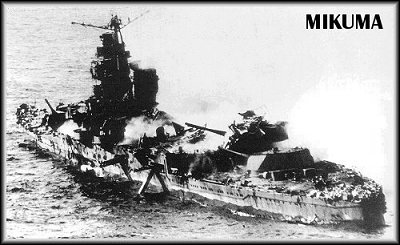
MIKUMA
(June 5, 1942)
|
|||||
| July 1, 42 |
MONTEVIDEO MARU
(July 1, 1942)
Sunk by the American submarine USS Sturgeon (Lieutenant Commander
Wright) off Cape Bojidoru, Luzon, in the Philippines. She was heading for
Japan from Rabaul, New Britain, carrying 1,035 Australian nationals
including 845 army prisoners of war, the bulk of the 2/22 Battalion,
Australian 8th Division (Lark Force ). The 7,267 ton passenger ship
had left Rabaul on the 22nd of June, unescorted, and unmarked when at 0225
hrs on July 1st, was hit by two torpedoes from a four torpedo spread from
the Sturgeon at a range of 4,000 yards. Developing a list to
starboard, the ship sank stern first at 0240. Later reports indicated that
845 army personnel, 208 civilian POWs, including twenty missionaries, who
had been living and working on New Britain when the Japanese came, 71
Japanese crew and 62 naval guards (a total of 1,186) made up the ships
complement. Among the 208 civilian prisoners were the 36 crewmembers of the
Swedish cargo ship Herstein which was bombed and set on fire while
loading copra in Matupi Harbor. From the Allied contingent on board, there
were no survivors.
Lives lost amounted to 1,053. |
|||||
| Sept 15, 42 |
USS WASP
( September 15, 1942) American aircraft carrier which as part of the British Mediterranean Fleet, assisted in escorting convoys to Malta. She was then transferred to Far Eastern waters where she took part in operations off Guadalcanal in the Solomon Islands. While south of the islands on September15, she was attacked by a Japanese submarine which scored three hits on the carrier. A heavy list to starboard developed after which she caught fire and sank. Most of her complement of around 2,000 were rescued but 193 of her crew were killed. |
|||||
 USS Wasp CV7
 |
http://members.tripod.com/davidmclellan0/index.htm | |||||
| Oct 1, 42 |
LISBON MARU
(October 1, 1942) Japanese transport vessel of 7,053-tons, carrying 1,816 British and Canadian prisoners of war from Hong Kong to Japan was torpedoed by mistake by the US submarine Grouper off the Chinese coast. The prisoners were contained in three holds which soon became foul with the stench of sweat, excreta and vomit. Many lost consciousness through thirst, lack of fresh air and extreme heat. Men were reduced to licking the condensation from the sides of the ships hull. A bucket of liquid was lowered by the guards and thirsty men rushed to grab it, only to find it was filled with urine. On top deck were some 778 Japanese military men on their way home to Japan. At 7 o'clock in the morning, the torpedo struck, severely damaging the ship but causing no casualties among the prisoners. Soon a Japanese ship, the freighter "Toyukuni Maru" came alongside and took on board all the Japanese soldiers but none of the Allied prisoners. The Lisbon Maru was then taken in tow heading for Shanghai, but some hours later the ship, now low in the water, began to sink by the stern. Prisoners in Number 3 hold were unfortunately below the waterline and now beyond rescue. Some prisoners in the other two holds managed to break free but were shot down as they emerged. Another four Japanese ships appeared on the scene and some escaped prisoners, swimming in the water, managed to reach the dangling ropes and started to climb aboard only to be kicked back into the water when within a few inches from the deck. Eventually, most of the surviving prisoners were taken on board the four ships and taken to Shanghai where thirty-five sick and wounded were unloaded. A few however, managed to swim away from the Lisbon Maru and were rescued by Chinese fishermen and taken to a group of small islands nearby. At Shanghai, a roll call accounted for 970 men, a total of 846 had perished, 154 were from the Middlesex regiment. Of the 970 survivors, some 244 died during their first winter in the Japanese camps. Toilets for POWs on these ships were primitive to say the least. They were hung like bird cages over the two sides of the ship. all swaying like swings in the wind. A prisoner hung on to the ropes and defecated directly into the ocean. In the wake of the ship two yellow coloured streaks could be seen trailing to the horizon, the result of droppings from dozens of these outboard 'benjos'. When the seas were rough, the prisoner got drenched but as toilet paper was unknown, what the hell, it was better than using your hands to clean yourself. But why bother, you may ask, back in the torrid holds of the ship you again sat in a few centimeters thick carpet of semi fluid human waste, blood, urine and vomit, the stench of which must have been horrific. Caged animals could not have suffered worse. |
|||||
| Nov 12-13, 42 |
USS JUNEAU
(November 12/13, 1942) American anti-aircraft cruiser named after the capital city of Alaska. During the night actions of the Naval Battle of Guadalcanal the Juneau was attacked by a torpedo from the Japanese submarine I-26. The torpedo was meant for the American cruiser San Francisco but missed and hit the Juneau. Badly damaged, the ship tried to escape from the battle zone but was again hit by a second torpedo which apparently hit the powder magazine causing the ship to explode in a great ball of fire. This time the Juneau sank, taking the lives of her Captain and 687 crew members, only 10 survived. On board the Juneau were the five Sullivan brothers, George, Francis, Joseph, Madison and Albert who had enlisted together and were serving on the same ship. After this tragedy, President Roosevelt issued instructions that in future if any American family lost more than two sons, the remaining boys would be relieved from further combat duty and sent home. A new ship The Sullivans was named in their honor and christened by the boys' mother in April, 1943. It was the first US Navy ship with a plural name and went on to earn 9 battle stars while serving in the Pacific theater. She was decommissioned in 1965 and is now moored at the pier side of the Naval and Servicemen's Park in Buffalo, New York. |
|||||
 USS Juneau
 |
http://www.geocities.com/Pentagon/4072/ | |||||
| Nov 13, 42 |
USS SAN FRANCISCO
(November 13, 1942) American heavy cruiser of 9,950 tons launched in 1933 and commissioned a year later. In 1942 she was part of the naval force covering the invasion of Guadalcanal. During the landings a Japanese torpedo bomber crashed on the aft superstructure of the ship killing fifteen men and wounding twenty-nine others. The San Francisco, flagship of Admiral Callaghan, was badly damaged during the Battle of Cape Esperance in which she received forty-five major hits from the Japanese battleship Hiei. On board the 'Frisco' 77 men had been killed including Admiral Callaghan (some reports say 115) and 105 men wounded. Limping back to Pearl Harbor before returning to the US for repairs, the San Francisco served out the rest of the war, earning seventeen battle stars. |
|||||
 USS San Francisco
http://www.geocities.com/mariwether.geo/sfa.html
USS San Francisco
http://www.geocities.com/mariwether.geo/sfa.html |
||||||
| Nov 13, 42 |
IJN HIEI
(November 13, 1942) Japanese Kongo class battleship sunk by bombs and torpedo hits during the half hour Naval Battle of Guadalcanal (off Savo Island) Damaged by shells from the USS San Francisco, her steering gear shattered, the Hiei was now careering all over the ocean. Her commander, Captain Nishida, then switched to manual steering and after nearly completing a 180 degree turn sailed the ship away from the battle area at reduced speed. Soon three B-17 bombers, from the American held Henderson Field on Gaudalcanal and in company with six torpedo carrying planes from the USS Enterprise, attacked the Hiei. Listing to starboard and down by the stern, the order was given to abandon ship and the evacuation of nearly 1,300 of its crew began. The Hiei, now abandoned, was left alone in the gathering darkness. It was never seen again. So were 188 of her crew who went down with her to the bottom of Ironbottom Sound. This was the first Japanese battleship sunk in WW11 and the first warship sunk by the US Navy since 1898. |
|||||
| - - 1943 - |
. . . The End of the Beginning . . . |
|||||
| Jan 02, 43 | Buna, New Guinea taken | |||||
| Jan 31, 43 | Germany surrenders army at Stalingrad | |||||
| Feb 09, 43 | Guadalcanal declared secure | |||||
| Feb 22, 43 | Kasserine Pass, Tunisia | |||||
| Mar 2-4, 43 | Battle of Bismarck Sea | |||||
| Apr 18, 43 | Yamamoto shot down by P-38s. | |||||
| May 14, 43 |
AHS CENTAUR
(May 14, 1943) Former passenger/cargo vessel, the Australian Hospital Ship Centaur (3,222 tons) sunk in 170 meters of water after being set on fire by a torpedo from the Japanese submarine I-177 near Cape Moreton, 38km off the Queensland coast. The Centaur had left Sydney Harbor while brightly illuminated in accordance with the Geneva Convention. Red crosses were painted on both sides of the hull and funnel and she flew the Red Cross flag. She was on her way to Port Moresby in New Guinea to pick up wounded from the battles of Buna and Gona, when the attack occurred at 0410hrs. The ship sank in about three minutes taking the lives of 268 people, including 18 doctors, 11 nurses, 193 other medical personnel of the 2/12th Field Ambulance and 45 members of her crew. There were 64 survivors from the 332 persons on board, picked up by the American destroyer USS Mugford. Of the twelve nursing sisters on board, only one survived. In 1990, the ship was declared a historic wreck. After the war, the captain of the I-177 , Lt-Cdr Hajime Nakagawa, was arrested and tried as a war criminal. He spent four years in Sugamo prison for atrocities committed in the Indian Ocean such as shooting survivors of torpedoed ships. (During the war 49 ships were sunk off the East Coast of Australia, a total of 1,287 lives were lost). |
|||||
 AHS Centaur
 |
||||||
| May11 - Jun 30 | US retakes Attu, Aleutians. | |||||
| Jun 21, 43 | New Georgia, Invasion, Solomon Islands | |||||
 click
for a larger view click
for a larger view |
Federal Shipbuilding & Drydock, Kearny, New Jersey 1943 | |||||
| Jun 30, 43 | Kiel Laid Down for the USS McGowan DD 678 | |||||
| Jul 5-17, 43 | Kursk tank battle | |||||
| Jul 6, 43 |
USS HELENA
(July 6, 1943) American light cruiser of 13,327 tons, sunk at the Battle of Kula Gulf 10 miles north of Kolombangara in New Georgia. Hit by three torpedoes from Japanese warships, the Helena jack-knifed and sank with 186 of her crew of 888. The survivors were picked up by other U.S. warships. About 400 of them later served on board the new USS Houston. The Helena was the last but one of the 10 American cruisers lost in WW11. The USS Helena was awarded 7 Battle Stars. |
|||||
 |
http://my.execpc.com/~brouchou/helena.html | |||||
| Jul 09, 43 | Allies invade Sicily | |||||
| Aug 05, 43 | Germany expelled from Russia | |||||
| Aug 06, 43 | Battle of Vella Gulf, Solomon Islands | |||||
| 09Sep-17Sep | Salerno, Italy | |||||
| 01Oct43 | Naples taken | |||||
| Nov 01, 43 | Marines land on Bougainville, Solomon Islands | |||||
| Nov 21, 43 | Makin and Tarawa Invasion, Gilbert Islands. | |||||
| Dec 20, 43 | USS McGowan DD678 Commissioned | |||||
| Nov 24, 43 |
USS LISCOMBE BAY
(November 24, 1943) American escort carrier sunk by torpedoes from the Japanese submarine I-175 (Lt. Cdr. Tadashi Tabata) near Makin Island in the Gilberts. The carrier sank in 23 minutes after being hit. Her aircraft bombs, stowed in the hold, blew up in a terrific explosion taking the lives of 644 men and its Commander, Rear Admiral Henry A. Mullinix. The stern of the ship simply vanished, the explosion sending fragments of steel, human flesh and clothing so high in the air that they showered down on the USS New Mexico which was following almost a mile behind. Fifty-five officers and 217 men were rescued by the destroyer USS Hoel. The I-175 managed to escape in spite of the many depth charges being dropped. Black mess steward and ships boxing champion 'Dorie' Miller was among the dead. Miller won the Navy Cross at Pearl Harbor by moving his mortally wounded captain to a place of greater safety and then manning a 50 caliber machine gun on the deck of the USS West Virginia until his ammunition ran out. As Miller remarked later 'I think I got one of those Jap planes'. He had no formal training in weapons. On June 30, 1973, the destroyer USS Miller was named in his memory. Legislative efforts to upgrade his Navy Cross to the Medal of Honor have to date been unsuccessful. |
|||||
| Dec 26, 43 | Cape Gloucester Invasion , Solomon Islands | |||||
| - - 1944 - | . . . the Long Road to Victory . . . | |||||
 click
for a larger view click
for a larger view |
Allied Advances to the Marianas 22 April to 24 July 1944 | |||||
 click
for a larger view click
for a larger view |
Allied Advances to the Palaus and Morotai 30 July to Sept 1944 | |||||
| Jan 22-May 23 | Anzio, Italy. | |||||
| Jan 29, 44 | Army lands on Admiralty. | |||||
| Jan 31, 44 | Marines land on Marshall Islands. | |||||
| Feb 3, 44 | McGowan Departs New York | |||||
| Feb 5, 44 | McGowan Arrives in Bermuda | |||||
| Feb 12, 43 |
KHEDIVE ISMAIL
(February 12, 1944) Egyptian transport of 7,513 tons requisitioned as a troopship while docked at Bombay in 1940. The ship was carrying 1,511 people including 178 ships crew, 996 men of the 301st Field Regiment, East African Artillery, 271 Royal Navy personnel and a detachment of 19 British Wrens. Also on board were 53 nursing sisters with one matron and 9 WTS girls (Women's Transport Service). While enroute from Mobasa, Africa, to Colombo, Ceylon, in convoy KR-8, the ship was torpedoed in the Indian Ocean. It took only 1 minute 40 seconds for the ship to sink taking 1,297 of her passengers and crew with her. There were only 214 survivors from the vessel, a victim of the Japanese submarine I-27 commanded by Lt-Cdr Fukumura. The I-27 was then blown apart by torpedoes fired from two of the escort destroyers, HMS Petard and HMS Paladin. |
|||||
| Feb 07, 44 | Kwajalein Invasion , Marshall Islands | |||||
| Feb18, 44 | Massive naval air raid on Truk, Carolines. | |||||
| Feb19, 44 | Marines land on Eniwetok Island. | |||||
| Time line | Fleet Admiral Ernest J. King, CIC US Fleet CNO, report for all naval operation 3-1-44 to 3-1-45 | |||||
| Mar 4, 44 | McGowan Departs from Bermuda | |||||
| Mar 6, 44 | McGowan Returns to New York | |||||

|
Brooklyn Navy Yard March 9, 1944
click for a larger view |
|||||
| Mar 15, 44 | Japan invades India. | |||||
| Mar 22, 44 | US lands at Hollandia, Dutch New Guinea | |||||
| Mar 22, 44 | McGowan Departs New York, Steams to Hampton Roads VA, turns north and steams to Rockland Maine | |||||
 |
North East Coast
click for a larger view |
|||||
| Mar 23 - 25, 44 | McGowan Cruises between Portland and Rockland Maine, | |||||
| Mar 25, 44 | McGowan Departs area and steams to Norfolk Virginia | |||||
| Mar 25, 44 | McGowan Arrives in Norfolk VA | |||||
| Mar 29, 44 | McGowan departs Norfolk, Steaming to Panama Canal | |||||
| Apr 2, 44 | McGowan Arrives at Balboa, Panama Canal For canal transit | |||||
| Apr 5, 44 | McGowan completes Canal Transit and heads north to San Diego California | |||||
| Apr 12, 44 | McGowan arrives at San Diego Navy Yard, California | |||||
| Apr 14, 44 | McGowan Departs San Diego, steams to Pearl harbor, Hawaii Islands | |||||
| Apr 19, 44 | McGowan Arrives at Pearl Harbor | |||||
| Apr 26 - May 6, 44 |
YOSHIDA MARU
(April 26-May 6,
1944) |
|||||
| May 31, 44 | McGowan Departs Pearl steams to Pacific War Theater of Operations | |||||
| Jun 04, 44 | Allies enter Rome | |||||
| Jun 06, 44 | D-Day, Normandy | |||||
| Jun 8, 44 | McGowan Arrives At Roi-Namur Atoll, ( Kwajalein Atoll ) Marshall Islands, Joins TG 52.17 | |||||
| Large Map of the Marshalls Islands Ailinginae, Ailinglaplap, Ailuk, Arno, Aur, Bikar, Bikini, Bokaak, Ebon, Enewetak, Erikub, Jabwot, Jaluit, Jemo, Kili, Knox, Kwajalein, Lae, Lib, Likiep, Majuro, Maloelap, Mejit, Mili, Namorik, Namu, Roi Rongelap, Rongerik, Taka, Ujae, Ujelang, Utrik, Wotho and Wotje
|
 Click for a larger view
 |
|||||
| Supplies arrive on Kwajalein after battle March 1944 |
 click for a larger view
 |
|||||
| Jun 10, 44 | McGowan departs with TG 52.17 heading for Saipan Invasion | |||||
| Jun 14, 44 | McGowan Arrives at Saipan , where she screened the bombardment ships. | |||||
| Jun 15, 44 | B-29 bomb Japan from China | |||||
| Jun 15- July 9 | Saipan Invasion , Mariana Islands |
 Click for a larger view
 |
||||
| On 13 June, seven
fast battleships and eleven destroyers began the initial naval bombardment
at 1040. This bombardment, which lasted until 1725, focused heavily on the
defenses inland of the landing beaches and on Garapan and Chalan Kanoa.
These two towns were essentially destroyed during the bombardment, but the
overall effect of the naval fire on the troops and the defensive positions
was minimal. The ships had to fire from at least 10,000 yards off the Saipan
coast since they were unsure of the presence of naval mines nearer the
island. Due to this fact, the ships were only able to target large buildings
since this was all that could accurately be observed. However, during the
bombardment, minesweepers swept the area west of Saipan as close as 2 miles
from shore and found no mines. During the night the naval bombardment
continued, but on a lower scale. On the 14th, seven large battleships, eleven cruisers, twenty-six destroyers and several other ships recommenced the bombardment. The efforts of the minesweepers the previous day allowed the ships to maneuver closer to the island. This reduced range allowed the naval gunfire from the ships to be much more accurate |
||||||
| Jun 15 - 22, 44 | During the invasion The McGowan added fire support to her duties, disposing of a fuel dump and artillery emplacements endangering forces on the beach. As the beachhead expanded, McGowan continued to support the assault forces with counter battery and harassing fire. | |||||
| Jun 19, 44 | Japanese carrier fleet defeated in Philippine Sea | |||||
| Jun 19, 44 |
SHOKAKU
(June 19, 1944)
Japanese aircraft carrier (25,675 tons) sunk about 140 miles north of the
island of Yap, during the two day Battle of the
Philippine Sea.
A spread of six torpedoes were fired from the submarine USS Cavalla
(Lt. Cmdr. Kossler) three of which struck the Shokaku. Badly damaged,
the carrier ground to a halt. One torpedo had hit the forward aviation
fuel tanks near the main hanger and planes which had just landed and
were being refueled, exploded into flames. Ammunition and exploding
bombs added to the conflagration as did burning fuel spewing from
shattered fuel pipes. With her bows subsiding into the sea and fires
now out of control, the captain gave orders to abandon ship. Within
minutes, total catastrophe struck the vessel. Volatile gas fumes had
accumulated throughout the vessel and when an aerial bomb exploded on
the hanger deck, a series of terrific explosions simply blew the ship
apart. The mighty carrier, now a blazing inferno, rolled over and slid
beneath the waves taking 887 navy officers and men plus 376 men of Air
Group 601, a total of 1,263 men in all, to the seabed. There were 570
survivors, including the carriers' commander, Captain Matsubara
Hiroshi. |
|||||
|
TAIHO
(June 19, 1944) The largest and newest carrier in the Japanese fleet, sunk west of Guam during the Battle of the Philippine Sea. It took only one torpedo hit from the USS Albacore to sink the 29,300 ton vessel, the flagship of Vice Admiral Jisburo Ozawa. The ship sunk after a catastrophic explosion caused by gasoline fumes igniting near an electric generator. Of a complement of 1,751 a total of 1,650 crewmen were lost. The USS Albacore (Lt. Cmdr. H. Rimmer) was lost during her 11th patrol off the coast of Japan, on November 7, 1944, after hitting a mine while submerging. Her entire crew of 86 perished. |
||||||
|
HIYO
(June 20, 1944) |
||||||
 Hiyo
Hiyo |
||||||
|
TAMAHOKO MARU
(June 24, 1944) Part of a convoy sailing towards Japan with 772 Australian, British and American prisoners of war on board. With the lights of Japan in sight, one of the ships in the convoy, exploded after being torpedoed by the U.S. submarine Tang. Nearby, the Tamahoko Maru was almost blown apart and water poured in through a gaping hole in her side. On top of the main hatch cover 80 men were sleeping. Not one of them survived. As the Tamahoko (6,780 tons) settled in the water, hundreds of prisoners jumped into the sea and soon a Japanese whale-chaser appeared and started picking up survivors. The final count was that 560 POWs had died. Of the 267 Australians on board only 72 survived. Fifteen US soldiers and sailors were killed as well as thirteen merchant seamen rescued from the sunk freighter American Leader. Next day, 212 survivors of the Tamahoko Maru were brought into the harbor at Nagasaki to spend the rest of the war in POW camp, Fukuoka 13. |
||||||
| Jun 22, 44 | McGowan departs Saipan area, steams to Eniwetak Atoll Marshall Islands | |||||
| Jun 25, 44 | McGowan arrives at Eniwetak Atoll | |||||
|
TOYAMA MARU
(June 29, 1944) Japanese 7,089-ton troop transport torpedoed by the USS Sturgeon. The vessel was carrying over 6,000 men of the Japanese 44th Independent Mixed Brigade from Kyushu to Okinawa. As the torpedoes hit, thousands of drums of gasoline exploded turning the holds into a fiery hell. There were about 600 survivors, a death toll of around 5,400. The year before on December 15, 1943, a total of 504 Canadian POWs from the Sham Shui Camp in Hong Kong were transported on the Soung Cheong to Japan via Takao, Formosa. At Takao, the prisoners were then embarked on the Toyama Maru and all were transported safely to Moji, Japan, on the 5/6th January, 1944. During the voyage, Rifleman Doucet of the Royal Rifles of Canada was beaten in a most brutal manner by the Japanese interpreter Nimori. Kicked in the stomach as he lay on the deck he never recovered from this attack and died in the Marumi POW camp a month later. Nimori was eventually tried by a British Military Court in Hong Kong and sentenced to fifteen years imprisonment. |
||||||
|
TAIHEI MARU
(July 9, 1944) Troopship of the Imperial Japanese Army sunk off the Chishima Islands in the Kuril Islands chain, probably by an American submarine. The ship departed from the port of Otaro in Hokkaido with around 2,000 troops and crew on board. The troops included 182 Koreans who were conscripted into the Japanese army during the Pacific War. Casualty toll on the Taihei Maru amounted to 956 deaths. (A total of 708 Koreans died while fighting for Japan during WW11). |
||||||
| Jul 16, 44 | McGowan Departs with Task force 53.1 for Guam Invasion | |||||
| Jul 21- Aug 10 | Guam Invasion |
 Click for a larger view
 |
||||
| Jul 21, 44 | McGowan screens transports carrying troops for the Guam Invasion, remained through the initial landing operations, Departs that night for the Tinian Island, Marianne Islands Invasion. | |||||
| Jul 21, 44 | McGowan then set course back to Saipan. There she rejoined TG 52.17 for screening and fire support missions during the Tinian phase of the conquest of the Marianas. | |||||
| Jul 24 -Aug 1 | Tinian Invasion |
 Click for a larger view
 |
||||
| On 24 July 1944, Task Force Fifty two point one seven, commanded by Rear Admiral Harry W. Hill, and the 2nd and 4th Marine Divisions, under the command of Major General Roy S. Geiger, invaded the island of Tinian. Defending the island were 9,162 Japanese Army and Navy troops. The successful invasion of Tinian hinged on a fake landing staged near "Tinian Town" (presently known as San Jose village). While the 2nd Marine Division pretended to ready an attack on the southern part of the island, even going so far as to lower boats and men into the water, the 4th Marine Division was launching a full-blown invasion on Tinian’s north side. The US Marine Landing Force overcame the numerically superior Japanese force on 1 August in what is considered to be the best-executed amphibious operation of the war. Marine casualties were 328 dead and 1,571 wounded. As on Saipan, many Japanese not killed by U.S. military forces opted to commit suicide by jumping off cliffs rather than being caught by the Americans. | ||||||
| Jul 25, 44 | Breakout from Hedgerows, Normandy | |||||
| Aug 7, 44 | McGowan departs Tinian Area and sets her course for Eniwetak, Island, Marshall Islands | |||||
| Aug 10, 44 | McGowan Arrives Eniwetak Island , Marshall Islands | |||||
| Aug 15, 44 | Allies invade southern France. | |||||
| Aug 18, 44 | McGowan Departs Eniwetak island, set course and steamed to Guadalcanal to prepare for the amphibious assault on the Palaus. | |||||
| Aug 21 44 | Falaise Pocket | |||||
| Aug 22, 44 | Japanese retreat from India | |||||
|
TSUSHIMA MARU
(August 24, 1944) Passenger/cargo ship of 6,754 tons, sunk by the US submarine USS Bowfin just north-west of the island of Akuseki. The Tsushima, unmarked and unlighted, was evacuating some 1,788 persons including children, school teachers and some parents, from Okinawa to the mainland of Japan prior to the American landings on the Ryukyu Islands. The attack on Convoy Namo 103, which included the Tsushima , was carried out at night between 10 and 11.30 pm. The ship sank in less than fifteen minutes and took the lives of 1,529 souls. Some survivors managed to cling to rafts for three days before being picked up. Of the 826 children on board, 741 drowned. There were only 59 child survivors. |
||||||
| Aug 25, 44 | Liberation of Paris | |||||
| Aug 25, 44 | McGowan arrives at Guadalcanal Island, Solomon islands | |||||
|
RAKUYO MARU
and KACHIDOKI MARU
(September 12\13, 1944) On September 4th, 2,218 Australian and British prisoners of war, who had survived the building of the Death Railway, were marched the three miles from the Valley Road camp in Singapore to the docks to board the two twenty-three year old passenger/cargo ships Rakuyo Maru (9,500 tons) and the Kachidoki Maru (10,500 tons). The Kachidoki was the ex US ship President Harrison salvaged by the Japanese. Both vessels were bound for Formosa. In the South China Sea, the convoy, consisting of three transports, two tankers and four escorting destroyers, was attacked by three American submarines, the Growler, Sealion and the Pampanito. The Rakuyo and Kachidoki were both sunk by torpedoes 300 miles west of Cape Bojeador, Luzon. A total of 1,144 British and Australian POWs lost their lives. Among those lost were thirty-three men from HMAS Perth. All told there were 1,074 survivors, 141 were picked up by the three submarines and the USS Queenfish and USS Barb which arrived later and in heavy seas rescued another thirty-two before heading for Saipan. The Japanese destroyers rescued 520 British prisoners from the Kachidoki (488 POWs and crew had died) and 277 British and Australians from the Rakuyo, to again become POWs. |
||||||
| Sep 8 , 44 | McGowan depart Guadalcanal Island and sortied with TG 32.2, for the invasion of Peleliu, Palaus | |||||
| Sep15- Oct 13 | Invasion of Peleliu, Palaus | |||||
| Sep 15, 44 | McGowan arrived in the transport area east of the Palaus | |||||
| Sep 17, 44 | McGowan with her transport group moved toward Angaur Island. There she took position in the antisubmarine screen. | |||||
| Sep 17, 44 | McGowan screened during the Invasion of Peliliu Island | |||||
| Sep17- 26 | A Bridge Too Far Operation Market Garden | |||||
|
JUNYO MARU
(September 18, 1944) The 5,065 ton Japanese cargo ship Junyo Maru , built in Glasgow by the shipbuilders Robert Duncan Co., was en route from Java to Sumatra when hit by two torpedoes from the British Triton Class submarine HMS Tradewind (Lt. Cmdr. S. Maydon) which had departed its base in Trincomalee on September 8. On board were 1,377 Dutch, 64 British and Australian Prisoners of War and a few dozen American merchant seamen. Also on board were 4,200 Javanese slave laborers bound for work on the 220km long railway line being built between Pakan Baru and Muaro in Sumatra. Packed into the holds like sardines, it was 'standing room only' with very little chance of escape in an emergency. The Junyo Maru was by this time just a rust bucket. The death toll amounted to 5,620 dead, the world's greatest sea disaster up till that time. A total of 723 survivors were rescued by Japanese ships, only to be employed on the building of the railway. Many did not survive the war. Of the 100 odd Dutch nationals who survived the sinking, ten died on the railway. As the ship was unmarked the submarine commander could not have known that the ship carried such a cargo. However, a few of these sinkings were carried out in the full knowledge that the ships carried prisoners-of-war. The Japanese naval code had been broken and was being deciphered and read by the Allies. The codes reported the sailing times, destinations and cargo of all convoys so the Allies knew which convoys were carrying prisoners. But the submarine commanders were ordered to attack the convoys, not any specific vessel. There was no way of knowing which of the ships carried POWs. |
||||||
| Sep 19, 44 | McGowan assists during the invasion of Angaur Island | |||||
|
HOFUKU MARU
(September 21, 1944) Japanese transport carrying 1,289 prisoners-of-war enroute from Singapore to Japan was attacked and sunk by US torpedo carrying bombers. Loaded with British and Dutch POWs, it stopped at Manila to unload the sick and dying. It sailed again in convoy and was attacked again when only three days out. It took only a few minutes for the ship to go down drowning around 1,047 men who were trapped in the holds. Less than 250 survived |
||||||
| Sep 23, 44 | McGowan departs Pelilu Islands , sets course and steams to the Admiralty Islands | |||||
 click
for a larger view click
for a larger view |
Carrier force for Leyte Operations | |||||
|
URAL MARU
(September 27, 1944) Japanese transport ship (6,374 tons) built in 1929, sunk by the American submarine USS Flasher 150 miles off Masinlik, Philippines. About 2,000 of the 2,340 people on board were drowned. |
||||||
| Sep 27, 44 | McGowan arrives at Manus Island , Admiralty Islands, the staging area for the upcoming Leyte operation. | |||||
| Oct 11, 44 | McGowan departed Manus Island, screening LSTs and LCIs of the 7th Fleet for the Leyte Invasion | |||||
| Oct 20 44 | US Landing on Leyte, Philippines | |||||
| Oct 20, 44 |
Arrived At Leyte Island, Philippine Islands. During the assault on Dulag she served as fighter-director for aircraft covering the landings. |
|||||
| Oct 23-26, 44 | Japanese battle fleet destroyed at Leyte Gulf. | |||||
|
MUSASHI
(October 23-26, 1944) The giant 64,200 ton Japanese battleship built at the Mitsubishi Shipyard in Nagasaki, was sunk during the Battle of Leyte Gulf. The super battleship took 6 torpedo hits and 17 bomb hits during four attacks from the 259 planes of Admiral Halsey's Third Fleet. The Musashi , her speed now down to six knots and her bows almost at sea level, then rolled over on her port side and sank taking 1,023 of her crew to their deaths. This was nearly half of her complement of 2,200 men. Her captain, Real Admiral Inoguichi Toshihira, went down with his ship. |
||||||
|
USS PRINCETON
(October 23-26, 1944) American light carrier was one of the six US warships sunk in the Battle of Leyte Gulf, the largest naval engagement since Jutland. The other five ships were the Gamber Bay (119 men were killed) and the USS St Lo, both escort carriers, the destroyers Hoel (202 killed) and Johnston (187 killed) and destroyer escort Samuel B. Roberts. Casualties from the six ships were 898 killed and 913 wounded. The Gamber Bay was the only American carrier sunk by naval gunfire in World War 11. |
||||||
|
ARISAN MARU
(October 24, 1944) Many other 'hell ships' sailed the pacific seas and were sunk during the last three years of the war but little is known about them. After the war investigators discovered that the Japanese had destroyed numerous records of these voyages. Between 1942 and 1945 it is recorded that 134 Japanese ships made 156 voyages carrying POWs. The number of prisoners amounted to 126,064 of which 21,039 died.
|
||||||
| Oct 25. 44 |
McGowan in the early hours of the 25th was the first to spot the Japanese ships on her radar in the Suragao straights, Leyte Gulf . During the battle she participated in DesRon 54's torpedo attack on Japanese men-of-war, weakening them as they steamed Up Suragao Strait into defeat at the hands of Rear Admiral Oldendorf and his battleline. |
|||||
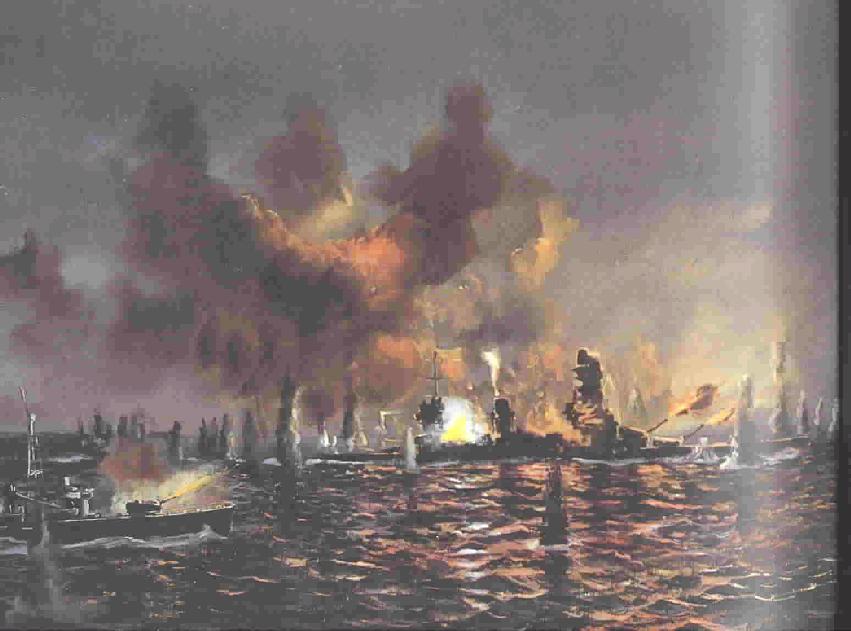 |
The battle of Surigao straights, Destroyer runs on the Japanese battle ships | |||||
|
USS ST. LO
(October 25, 1944) American aircraft carrier sunk in the Battle of Leyte Gulf by a Japanese Zeke-52 kamikaze aircraft. The plane hit the St. Lo at 10:53hrs. Shortly after, a massive explosion of her own magazines caused an enormous mushroom shaped cloud to rise above the doomed vessel. Another six or seven explosions occurred after her commander, Captain F. J. McKenna, gave the order to abandon ship. The St. Lo disappeared beneath the sea at 11:25 hrs taking with her 126 members of her crew. Her escort destroyer, USS Dennis, rescued 434 survivors. |
||||||
|
FUSO
(October 24-25, 1944) Japanese battleship (39,154 tons) sunk during the night Battle of Surigao Strait, Leyte, by a torpedo from the American destroyer USS Melvin. Badly damaged, she lost speed and fell out of formation only to blow up in a cataclysmic explosion half an hour later at 0340hrs. The Fuso (Admiral Masami Ban) broke in two parts, the two sections remaining afloat and blazing furiously only a short distance from the northern tip of Kanihaan Island. The bow section was sunk by gunfire from the USS Louisville and the stern section sank half an hour later after having drifted with the current for some distance. Many survivors swimming in the sea refused to be rescued by US ships. The Japanese destroyer Asagumo may have, or may not have, rescued some of Fuso's survivors but she herself was torpedoed and sunk with all on board some four hours later. Those that survived the sinking of the Fuso and made it to shore, were butchered by Philippine natives out for revenge. The entire crew of the Fuso therefore died, the exact number is not known but estimates put her full complement at just over 1,400 men. (The last Japanese battleship still afloat at war's end was the NAGATO. It was sunk off Bikini Atoll during one of the atomic bomb tests in 1946) |
||||||
 Fuso
Fuso |
||||||
|
YAMASHIRO
(October 24-25, 1944) Flagship of Vice Admiral Nishimura Shoji and sister ship of the Fuso, sunk during the Battle of Surigao Strait. As the formation entered the Strait, the ships were attacked by PT Boats and destroyers of the US Battle Force under the command of Admiral Jesse B. Oldendorf. One of her escorting destroyers, the Yamagumo, hit by a torpedo, blew up and sank with all hands. The Yamashiro, after being hit by four torpedoes, started to list and when the list reached 45 degrees the order to 'Abandon Ship' was given. The order came too late, for after two minutes the ship abruptly capsized taking most of her 1,400 crew to the depths. There were only ten survivors who were rescued by the USS Claxton. |
||||||
 Yamashiru
 |
 Yamagumo
 |
|||||
| Oct 26, 44 |
McGowan departs the Suragao straights and underway for Palau Island, |
|||||
| Oct 28 44 |
McGowan Arrives at Palau Island , Palau island Chain and departs later that day and gets underway for Hollandia, Dutch New Guinea from where she screened convoys to the Philippines until after the Mindoro landings in December. |
|||||
| Oct 30, 44 | McGowan arrives Hollandia Dutch New Guinea | |||||
| Nov 9, 44 |
McGowan departs Hollandia, Dutch New Guinea, Convoy Screen |
|||||
| Treasure ship |
NACHI
(November 5, 1944) Japanese heavy cruiser(13,380 tons. Captain Kanooka Enpei) In an attempt to escape American air raids on Manila harbour, the Nachi headed for the open sea but another strike from Halsey's Task Force 38, caught the Nachi just off Corregidor. Immobilized with bomb hits and a torpedo strike in the starboard boiler room, the ship lay dead in the water only to be attacked again by another air strike, this time taking 5 torpedo hits. The Nachi simply blew apart and sank at 1645hrs. A total of 807 of her crew died, plus 74 Fifth Fleet staff. There were 220 men who survived the blast. (This is according to the official US Navy report) The latest version of the sinking of the NACHI. The cruiser was damaged in a collision with the Japanese cruiser Mogami and needed repairs in Japan. Before sailing she was loaded with 100 metric tons of looted gold bullion and towing a barge loaded with drums full of silver and gold coins, diamonds and gemstones. The Nachi sailed out into Manila Bay where she was deliberately torpedoed by a Japanese submarine lying in wait. All crew were machine-gunned in the water. The looted gold was to be retrieved after the war. In 1975 the first attempt was made to find the wreck but ended in failure. Later that year, President Ferdinand Marcos of the Philippines financed an expedition to recover the treasure and according to numerous sources finally recovered the gold which in 1975 was worth six billion US dollars. Gold at that time was selling at $65 an ounce. Other Marcus assets, deposited in Swiss banks, were frozen in 1998. Now (July 2003) these assets total 1.6 billion dollars. The Philippine Supreme Court has requested this money be returned to the Philippine Government. Swiss authorities have agreed to do this. |
|||||
 Nachi
Nachi |
||||||
|
USS MOUNT HOOD
(November 10, 1944) Named after the 11,225 foot high extinct volcano in the Cascade Mountains in Oregon. Commissioned on August 6, 1944, she set sail on the 21st of October bound for the Pacific Theatre via the Panama Canal. Fully loaded with ammunition and explosives, the Mount Hood anchored at Seeadler Harbor in the Admiralty Islands, the largest American Naval Base west of Pearl Harbor. There, on the 10th of November, while the ship was dispersing ammunition to other vessels preparing for the invasion of the Philippines, the ship blew up at 08.55hrs in a terrible explosion sending up a smoke cloud 7,000 feet into the air. The largest part of the ship found after the explosion measured 16ft by 10ft. The ships former position was shown by a trench on the harbor floor, 300 feet long, 50 feet wide and 35 feet deep. The Mount Hood and all its crew aboard at the time, simply disappeared. The tragedy took the lives of 295 men aboard the ship plus 49 men killed on other ships in the harbor, 371 men were injured. There were 18 survivors from the Mount Hood who were ashore when the ship blew up. Thus ended the ships career, after only four months service. Controversy still rages as to whether this accident was the result of careless handling of ammunition or a torpedo from a Japanese midget submarine. |
||||||
| Nov 14, 44 | McGowan arrive at Leyte Island Philippines Islands , | |||||
| Nov 15, 44 | McGowan departs Leyte island for the return to Hollandia, Dutch New Guinea | |||||
| Nov 19, 44 | McGowan arrives in Hollandia, Dutch New Guinea | |||||
|
KONGO (November 21, 1944) Built in Britain by Vickers & Son at Barrow. On October 25th, 1944, the 36,601 ton Japanese battleship Kongo was badly damaged by air attacks during the Battle of Leyte Gulf. A gash on her starboard side opened up fifteen oil tanks, the contents of which poured into the sea. The damage forced the Kongo to attempt a return voyage to Japan for repairs. While plowing through rough seas in the Formosa Strait she was attacked by the American submarine USS Sealion (Captain Eli Reich). Two torpedoes hit the battleship causing a list of 20 degrees. Heading for the nearest port of Keelung on Formosa, some sixty-five nautical miles distant, the list increased to 45 degrees. It became obvious to the captain and crew that the Kongo was sinking and the order to 'Abandon Ship' was given. When the list accelerated past 60 degrees, tragedy struck. Her forward 14-inch magazine exploded with horrifying results and the Kongo rolled over and slipped under the waves. Some 1,250 officers and men were lost. Her escorts, the destroyers Hamakaze and Isokaze rescued survivors. The Hamakaze picking up seven officers and 139 men, the Isokaze rescued six officers and 85 men, a total of 347 survivors. A third escort, the destroyer Urakaze, was also sunk by the Sealion taking all hands, 307 men, to their deaths. |
||||||
 Kongo
Kongo |
||||||
| Nov 24, 44 | The Start B-29 raids on Japan from Tinian | |||||
| Nov 25, 44 |
McGowan departs Hollandia |
|||||
|
KUMANO (November 25, 1944) Japanese heavy cruiser, a survivor of the Battle of Leyte Gulf. (in which Japan lost 26 ships, the US, 6 ships) The badly damaged vessel lost 56 officers and men killed and 99 wounded. The Kumano (Captain Hitomi Soichiro) managed to escape to Manila for repairs. On her next sortie she was hit by torpedoes from a US submarine but again made it home. Dubbed the 'ship with nine lives' her luck finally ran out on 25th November when, en route to Formosa, she was attacked by Avenger planes of Air Group 80 from the carrier USS Ticonderoga. Four direct hits by 500 lb bombs slowed the ship down but next came an attack with aerial torpedoes scoring 5 hits on the disabled ship. Listing at an angle of 45 degrees the order to 'Abandon Ship' was given. The Kumano then turned turtle, her hull showing above the water. Survivors clinging to the hull and swimming in the water were subjected to strafing by the American planes. At 5.15pm she slid under the waves taking 440 men including her captain, out of a complement of 1,036, with her. In all, she had absorbed a total of eight torpedoes and six bombs before sinking. |
||||||
 Kumano
 |
||||||
| Nov 28, 44 | Antwerp port opened | |||||
| Nov 29, 44 | McGowan arrives Hollandia, Dutch New Guinea | |||||
|
SHINANO (November 29,1944) Named after the Shinano province of Japan, this 71,890 ton super battleship, now converted to the world’s largest aircraft carrier, set sail on her maiden voyage on November 28, 1944, escorted by three destroyers. Enroute to the safety of the Inland Sea to conduct her sea trials, she was spotted by the American submarine USS Archer-Fish commanded by Joseph F. Enright USN. On board the Shinano were 2515 officers and men plus some 300 shipyard workers and 40 civilian employees. The Archer-Fish fired a volley of six torpedoes, four of which struck the carrier on the starboard side causing a torrent of sea water to flood in. Developing a list of over 20 degrees the mighty ship lay dead in the water. Her escort destroyers came alongside to take off the crew, shipyard workers and civilians, who had started to panic. Hundreds of others jumped into the sea, clinging to anything that would float. Too weak to haul themselves aboard the destroyers they fell back into the water and drowned. Her short life of 17 hours at sea ended at 10.55 hrs. on the 29th November when the brand new carrier slid to the bottom without having once fired her guns. From her complement of 2,515 a total of 1,435 souls perished. There were 1,080 survivors including 55 officers, 993 ratings and 32 civilians. Joseph F. Enright, commander of the Archer-Fish, was awarded the Navy Cross at Pearl Harbor in March, 1945. The commander of the Shinano, Captain Toshio Abe, went down with his ship. Archer-Fish ended her career in 1968 on the ocean floor off San Diego when she was used as a target for a new type of torpedo fired by the nuclear submarine USS Snook. |
||||||
 Shinano
 |
||||||
|
ORYOKU MARU and BRAZIL MARU (December 1944) These two 7,000 ton Japanese passenger ships were being used to transport some 1,619 American Prisoners of War, mostly officers, to Japan. Marched through the streets of Manila from the Bilibid POW Camp to Pier 7 for boarding, the prisoners were crammed into the holds, standing room only. Also on board were around 700 civilians plus 100 crew and 30 Japanese guards. Already overloaded, the Oryoku Maru then took on about 1,000 Japanese seamen, survivors of ships sunk in Manila Harbour. It was spotted on her next day out at sea by US Navy carrier planes and attacked. The Oryoku Maru sailed into Subic Bay in the Philippines and ran aground to prevent her sinking. The attack continued over a period of two days in which 286 US soldiers were killed. The survivors, who were forced to swim ashore, were then transported by truck and train to San Fernando and thence to other ships, the Enoura Maru and Brazil Maru. Reaching Takao in Formosa, the Enoura Maru was bombed, killing around 316. The survivors, numbering 925, were then transferred to the Brazil Maru which also carried a cargo of 12,000 bags of sugar, and sailed for Japan on January 14, 1945. Conditions on board were indescribable, hundreds dying on the way from the cold, lack of air and water. On arrival at Moji in Japan two weeks later, only 475 were alive. Of these, 161 died within the first month ashore. Of the original 1,619 Americans on board the Oryoku Maru, around 300 had died. In a period of just over six weeks American submarines had killed over 4,000 Allied POWs. During the year (1944) about 53 of these hell-ships had sailed carrying a total of 47,057 prisoners to different destinations. The casualty rate was thirteen hell-ships sunk with 17,383 lives lost. That same year there were 674 deaths aboard these 'hell ships'. The deaths were not attributable to air or submarine attacks but to illness, suicide and murder (prisoner killing another prisoner) Crazed by thirst, prisoners would drink their own urine or slash their wrists for a mouthful of blood. Others would kill their companions and bite open an artery in the neck to get to the blood. Thirst would turn a man into a vampire. One prisoner who survived the war stated "Some prisoners fell into depravities of which I, for one, did not realize the human race was capable". In the latter part of 1944, murder became commonplace on ships carrying American soldiers. Back in 1942, murders were committed among British POWs on board the Dainichi Maru. In 1944, there were no reports of homicide among British, Dutch or Australian prisoners. Of all the nationalities that were transported on these hell-ships, all were subjected to the same inhumane conditions, yet, it seems that only Americans killed each other. Crowding and sanitary facilities were a serious problem on all troopships whether Allied, Axis or Japanese. The Japanese maintain that their own troops suffered the same conditions as Allied prisoners (without, of course, the deliberate starvation). Australian POWs were always amazed at the brutality of Japanese officers towards their own men. Slapping, kicking and punching were commonplace, an everyday occurrence. Is it so surprising then that prisoners were treated so badly by the Japanese soldier? |
||||||
| Dec 13, 44 |
McGowan departs Hollandia, screening convoy to Lyte island |
|||||
| Dec15, 44 | Landing on Mindoro, Philippines | |||||
| Dec 16, 44 | McGowan arrives at Leyte island | |||||
| Dec 19, 44 | McGowan departs Leyte Island | |||||
|
IJN UNRYU (December 19, 1944) The Imperial Japanese Navy aircraft carrier Unryu was sunk during her first war voyage at sea. Torpedoed by the USS Redfish, the Unryu had only been in commission for six months after the devastating losses at the Battle of Midway. The ship was loaded with a special cargo of thirty 'Ohka' rocket propulsion bombs before being sent on her way to confront the US invasion forces during the Luzon landings. The torpedo struck the Unryu on the starboard side setting off the deadly Ohka bombs stored in the lower deck hanger. The detonations literally blew the bow area apart. After the boiler rooms flooded, the ship listed to over 30 degrees and the order to 'Abandon Ship' was given. Minutes later, with a 90 degree list, the carrier plunged headfirst to the bed of the East China Sea. Casualties were appalling: Captain Kaname Konishi and 1,238 officers and men, plus an unknown number of passengers, lost their lives. There were only 14 survivors. |
||||||
| Dec16, 44 | Battle of the Bulge Begins | |||||
| Dec 22, 44 | McGowan arrives Mindoro Island Philippines, and then steams to Leyte Island Phillippines | |||||
| Dec 24, 44 | McGowan arrives at Leyte Island Philippines | |||||
 click to enlarge
 |
||||||
| - - 1945 - - | . . . the War is Concluded . . . | |||||
| Jan 5, 45 |
McGowan departs Leyte Island setting course for Lingayan Gulf and the invasion force on Luzon Island |
|||||
| Jan 09, 45 | Landing on Luzon | |||||
| Jan 11, 45 | McGowan arrives at in the Lingayen Gulf, to take part in the Luzon offensive. As part of the antiaircraft screen off the San Fabian beachhead, she warded off the suicide planes of the Japanese Special Attack Corps until the | |||||
| Jan 14, 45 | McGowan departed Luzon and returned to escort work. | |||||
| Jan 16, 45 | Battle of Bulge ends | |||||
| Jan 19, 45 | McGowan arrives at Leyte island | |||||
|
USS TICONDEROGA (January
21, 1945) |
||||||
| Jan 23, 45 |
McGowan arrived at Ulithi Island, Caroline Island Chain ,there she joined the fast carriers, TF 58, |
|||||
 Click to enlarge
 |
||||||
| Feb 4-11,45 | Yalta. USSR to enter Pacific War | |||||
| February 10 | McGowan depart Ulithi Island Speeding north with Task Force 58, they struck; at Honshu | |||||
| Feb 13, 45 | Fire bomb Dresden | |||||
| Feb 16, 45 |
McGowan Operating with Task Force 58, struck at Honshu, Japan this was the first Carrier Raid on the Japanese home islands |
|||||
| Feb 17, 45 | McGowan and the Task force 58 departed the area setting a southerly course to support the Iwo Jima landings | |||||
| Feb 18, 45 | McGowan arrived at Iwo Jima they supported the Iwo Jima campaign | |||||
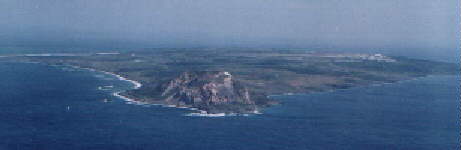
| Feb 19- Mar 16, 45 | Battle for Iwo Jima
|
|||||
|
Iwo Jima Island |
|
|||||
| Feb 21 45 |
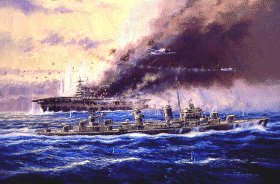 Carrier Saratoga was hit by Kamikaze |
|||||
| Feb 22 45 |
 |
Burial at sea on McGowan" Aircraft carrier Saratoga causality"
Click to enlarge |
||||
|
USS BISMARK SEA (CVE-95) (February 21, 1945) The 10,982 ton escort carrier was launched in 1944 under the name 'Alikula Bay ' and later renamed Bismark Sea. Joined the US 7th Fleet and saw action off Leyte and in the Lingayen Gulf landings. While taking part in the Iwo Jima invasion, the Bismark Sea was attacked by three Japanese kamakazi planes from the island of Kyushu, Japan. One of the planes crashed onto her deck, the other two were shot down. An explosion in her ammunition store caused uncontrollable fires and in spite of all efforts of her crew to save the ship, the carrier sank ninety minutes later. Of her complement of 860, a total of 318 men lost their lives. |
||||||
| Feb 25. 45 | Arrive Eniwetak Island Marshall Islands | |||||
| Feb 27 45 | Depart Eniwetak island | |||||
| Mar 03, 45 | Manila liberated | |||||
|
March 3 Arrive Saipan Island Marianna island |
||||||
| march 4 Depart Saipan | ||||||
| March 5 Arrive ulithi island , Caroline island Chain | ||||||
| Mar 07, 45 | Remagen Bridge | |||||
| Mar 09, 45 | Fire bomb Tokyo | |||||
| March 14 | Depart Ulithi Island returned to the Japanese home islands for further strikes. | |||||
| March 18 | Carrier Franklin hit Kobe burial at sea | |||||
| March 18 | Coulers TF 58 Kyushu | |||||
| March 18 | Left Area | |||||
| March 18 | 14 Bettys Shot down Rescued Two pilots | |||||
|
USS FRANKLIN (CV-13) (March 19, 1945) American aircraft carrier attacked by Japanese planes off Samar Island. Two direct hits by 550lb bombs caused fires and internal explosions but failed to sink the ship. A total of 725 men were killed and 265 injured. The Franklin had a crew of 3,450 officers and men. After the war, 393 bravery decorations were awarded to the crew, including one Congressional Medal of Honor awarded to naval chaplain Lt. Commander Joseph O'Callahan for heroism. The Franklin (commanded by Capt. Gehres) was the most severely damaged US ship to survive but managed to make her way back to Ulithi Atoll in the Caroline Islands and finally to the US for repairs. |
||||||
| Mar 21, 45 | Mandalay, Burma regained. | |||||
| Mar 22-23, 45 | Patton & Montgomery cross Rhine | |||||
| March 23 | Rescued one Pilot | |||||
| March 23 | First Carrier raids on Okinawa Jima | |||||
| Treasure Ship |
AWA MARU (April 1, 1945) Japanese passenger/cargo ship of 11,249 tons, Captain Hamada Matsutaro, sunk while homeward bound after having delivered Red Cross relief supplies to American and Allied POWs in Japanese custody under an agreement between Japan and the US Government which guaranteed safe passage for such ships. The third ship to carry out this relief programme was the Awa Maru which picked up the Red Cross parcels from the stockpile at Nakhodka, one hundred miles south of Vladivostok. They had been transported there by five Soviet ships which had sailed from Portland, Oregon, in December, 1943, loaded with 2,500 tons of supplies. The Awa Maru was painted green with large white crosses on her sides and funnel, all illuminated by special spot lights. Loaded with 175 tons of Red Cross supplies, the Japanese also loaded crates of aircraft parts, munitions and other commodities desperately needed by Japanese troops in Southeast Asia. This was in complete violation of the Relief for POW agreement. After unloading her cargo at various stops on her journey south, the Awa Maru was now in Singapore preparing for the journey home to Japan. Before leaving Singapore on March 28, she had on board over 2,000 Japanese officials, diplomats, technicians, war loot and civilians, all eager to escape the Allied bombs that were now falling on the city. The war loot consisted of forty metric tons of gold and 150,000 carats of diamonds, all worth over $5 billion. Calling at Jakarta, she took on 2,500 tons of crude oil, hundreds of tons of oil drilling machinery, tin ingots, tungsten and rubber. Although the Americans knew what was going on they were reluctant to do anything about it in fear that the relief supplies would be stopped. Submarine commanders were ordered to 'let it go by safely'. However, April 1st saw the US submarine Queenfish , Commander Charles E. Loughlin, on her fourth patrol, in the Taiwan Strait in an area near where the Awa Maru would have to pass through. At 11 pm, a pip appeared on the Queenfish's radar indicating a possible target at 17,000 yards. Loaded far beyond normal limits, and traveling low in the water, the ship presented a smaller than usual radar image not unlike that of a destroyer. What happened next proved to be the greatest submarine error of the Pacific war. The Queenfish fired four torpedoes, all of which hit the target. As the submarine approached the oil covered spot where the target had sunk, the crew picked up one exhausted man from the water, a first class steward from the sunken ship, 46 year old Shimoda Kantaro, the only survivor of the Awa Maru. Drowned in this disaster were 2,003 persons including seventy -two Taiwanese civilians. On arrival back at base, Commander Loughlin was relieved of his command and faced court-martial the result of which cleared him of all charges of wrongdoing. As the ship was sunk in Chinese territorial waters, Beijing carried out the salvage and recovered the looted treasure. |
|||||
| Apr 01- Jun 21- 45 | Battle for Okinawa | |||||
| Throughout April and May they provided support for the troops fighting on Okinawa as they struck at enemy military and industrial targets from Formosa to Kyushu. | ||||||
|
YAMATO (April 7,1945) Japan's 71,659 ton, 862 ft long super battleship Yamato, commissioned on 16th December, 1941, was the world's largest fighting ship afloat. She carried nine 18.1 inch guns which could hurl a shell a distance of 35 miles. As the Americans prepared to invade the island of Okinawa, the Yamato set sail from Tokuyama with the cruiser Yahagi and eight escort destroyers under the command of Vice-Admiral Ito Seiichi, on what was considered a suicide mission, to engage the American amphibious fleet as it approached the island. Sailing with nine escorts but without air cover, the Yamato was soon spotted by a US scout plane which radioed its position to the invasion fleet. Within hours the mighty battleship was attacked by an armada of 386 fighter planes and torpedo carrying bombers from the flight decks of the invasion fleet carriers. Hit by at least eight torpedoes and many bombs during the two-and-a-half hour battle, the Yamato developed a 120 degree list to port after one of her magazines exploded. Minutes later the great ship capsized and sank at 14:23 hrs off the coast of Kyushu, taking with her 2,498 members of her crew including Admiral Ito. Of her full complement of 2,767 men, there were only 269 survivors. The cruiser Yahagi was also sunk with the loss of 446 lives. Another 721 lives were lost from the sinking of five of her escort destroyers. Total casualties from the five ships were 3,665 dead. The sinking of the Yamato was the largest single loss involving a warship in history. |
||||||
 Yamato
 |
||||||
| Apr 12, 45 | F. D. R. dies in office, Truman becomes President. | |||||
| Apr 29, 45 | USS Hazelwood hit by Kamikaze midships at # 1 Stack, McGowan takes her into tow | |||||
| Apr 30, 45 | Hitler commits suicide. | |||||
| May 03, 45 | Rangoon freed. | |||||
| May 07, 45. | Germany surrenders. V. E. DAY | |||||
| Replenishing in the Philippines in early June, they extended their range northward again and by 1 July were headed for objectives on Honshu, Hokkaido and the Kuriles | ||||||
|
ASHIGARA (June 8, 1945) The 13,380-ton Nachi class Japanese cruiser sunk by the British submarine HMS Trenchant commanded by 'Baldy’ A. R. Hezlet. (It was estimated that around 1,200 Japanese troops were on board on their way from Batavia to reinforce the garrison at Singapore). At the last minute, the Ashigara had altered course and was hit by five torpedoes out of the eight fired by the Trenchant. In an effort to beach herself she headed towards Klipped Shoal near Sumatra but half an hour after being hit, the blazing Ashigara capsized and sank. A total of 853 survivors were rescued by the Japanese escort destroyer Kamikaze. Commander Hezlet was later awarded the DSO and the United States Legion of Merit. |
||||||
| Jun 10, 45 | Australians invade Borneo. | |||||
|
USS BUNKER HILL (CV-17) (June 27, 1945) Aircraft carrier operating off the island of Okinawa, hit by a Japanese kamikaze suicide plane. The ship suffered the loss of 373 crewmen when the re-armed and re-fuelled planes on deck exploded and caught fire. The Bunker Hill did not sink but made it home to the Puget Sound Naval Shipyard for repairs. Air attacks by Japanese planes on American ships off Okinawa killed 2,658 men during ten kamikaze attacks in which eleven ships were sunk and 102 damaged. During the Pacific War, 288 United States Navy ships were hit by kamikazes, 34 were sunk. (Kamikaze units, was first formed in October,1944, as a Special Attack Force called 'Shimpu' by Vice Admiral Takijiro Onishi and included 23 volunteer pilots. A second unit was formed soon afterwards under the name Kamikaze 'Divine Wind ' after a typhoon that destroyed a Mongol invasion fleet way back in 1281 AD. In their suicide attempts, 1,465 aircraft were destroyed. |
||||||
| Jun 30, 45 | Luzon declared secure [fighting continues] | |||||
| Following the strikes on the Kuriles, McGowan was detached from T F. 38 and ordered back to the west coast for overhaul. | ||||||
| July 16, 45 | Atomic bomb test Alamogordo, NM | |||||
|
USS INDIANAPOLIS (CA-35) (July 30, 1945) Launched on the 30th of March, 1930, this 9,950 ton heavy cruiser served throughout the Pacific War until its final mission. One of the wars most secret missions was the delivery of the uranium core to be used in the 'Little Boy' Hiroshima bomb. After unloading the component to the B29 Bomb Squadron on the island of Tinian, the Indianapolis departed for Leyte to join up with the USS Idaho for gunnery practice before rejoining the rest of the US Fleet off Okinawa for the expected invasion of Japan. Halfway between Leyte and Guam, the cruiser was hit by torpedoes from the Japanese submarine I-58 (Captain Hashimoto). The Indianapolis rolled over and sank bow first taking the lives of 883 US sailors. (Position 12 degrees-2 minutes north by 134 degrees-48 minutes east) There were 316 survivors from the 1,199 crew. Most of the men died in the water from exposure and shark attacks. Of the thirty nine Marines on board only nine survived. The survivors were rescued four days later by the US destroyers Cecil Doyle, Talbot and Dufilho. After hospital treatment on Guam the survivors were soon on their way home on board the carrier USS Holandia . The captain of the Indianapolis, Charles Butler McVay, was later court-martialed for failing to zig-zag in hostile waters. His sentence was remitted by the Secretary of the Navy, James Forrestal, and he was restored to duty. He retired as a Rear Admiral in 1949 and in 1968, in Litchfield, Connecticut, he committed suicide by a pistol shot to the head. In July, 2001, Captain McVay was exonerated for the loss of his ship. The Indianapolis was the last major warship sunk in WW11 and America's greatest disaster at sea. How different would history have been if the cruiser was sunk on the outward journey taking the nuclear components to the bottom of the ocean? |
||||||
 USS Indianapolis
 |
||||||
| Aug 06, 45 | First "A" Bomb dropped on Hiroshima | |||||
| Aug 08, 45 | USSR invades Manchuria. | |||||
| Aug 09, 45 | Second "A" Bomb dropped on Nagasaki | |||||
| Aug 14, 45 | Japan surrenders. V. J. DAY | |||||
|
UKISHIMA MARU (August 24, 1945) In the Aomori Prefecture, in the far north of Japan, around 5,000 Korean slave labourers had spent the last few years of the war digging a major underground complex of tunnels and storage facilities. With the work completed and the end of the war just a few weeks away the five thousand labourers were put aboard the Japanese warship Ukishima Maru with the promise that they were being returned to their homeland. The warship sailed south along the west coast until it reached the Maisaru Naval Base in Kyoto. There, the hatches to the holds were sealed down and the ship taken offshore and scuttled. Explosives were placed inside the hull, the resulting explosions sinking the ship within minutes. There were only some 80 survivors. Fifty-seven years later, in August 2001, fifteen of the survivors who were still alive, won a lawsuit for compensation against the Japanese government. They were paid the paltry sum of $30,000. |
||||||
| Treasure Ship |
OP ten NOORT (August 30, 1945) A 6,000 ton Dutch passenger liner based in Java and on regular service between Surabaya and Singapore. Converted to a hospital ship for the Dutch Navy at the outbreak of the war. In harbour at Surabaya during the Battle of the Java Sea, she was dispatched to look for survivors but was intercepted by two Japanese destroyers and ordered to turn back to Bandjarmasin in Borneo where she was boarded and apprehended. Ordered to take on board 970 Allied prisoners-of-war, including around 800 survivors from the British cruiser Exeter sunk in the Java Sea battle, she sailed for Makassar and there, for the next eight months served as a hospital facility for the POW camps in the area. Later she sailed for Yokohama under the Japanese flag and a new name 'Tenno Maru'. For the remainder of the war she sailed between Singapore and Manila carrying looted gold and other treasures from the Japanese occupied countries. Just weeks before the war ended she arrived again in Yokohama loaded with 2,000 metric tons of gold but instead of off-loading her cargo she then sailed on to the Maisaru Naval Base where more gold and platinum bars, diamonds and other gems were put on board. (A metric ton of gold equals 26,400 ounces) Realizing the war was over it was decided to sink the ship and recover the treasure at a later date. Just days before the Japanese surrender the Op ten Noort was taken out into Maisaru Bay late at night by a group of high-ranking Japanese naval officers. The Japanese captain and twenty-four crewmen were shot dead and the ship scuttled. When the wreck was found in 1990 the Japanese valued the treasure at thirty billion US dollars (Three trillion Japanese yen) |
|||||
| While at Adak, 14 August, she received word of the Japanese surrender. Assigned to the 9th Fleet she steamed back to Japan for occupation duty in the Ominato Naval Base area | ||||||
| Sep 02, 45 | Japans Signing of Surrender Document on USS Missouri | |||||
| On 12 October she departed Honshu for the United States. Arriving in November she underwent overhaul, | ||||||
| 30 April 1946 she decommissioned and entered the San Diego Group, Pacific Reserve | ||||||
.
A TOTAL OF 185 US SAILORS WERE KILLED BY 'FRIENDLY FIRE' DURING WW11, 438 WERE WOUNDED.
KAMIKAZE ATTACKS ON US WARSHIPS CAUSED THE DEATHS OF 3,593 AMERICAN SAILORS, 5,538 WERE WOUNDED.
IN ALL US NAVAL ACTIONS DURING WW11, 56,683 AMERICANS WERE LOST AT SEA. THIS INCLUDES MEN OF THE US MERCHANT MARINE OF WHOM SOME 6,830 WERE LOST AND SIXTY DIED IN PRISON CAMPS.
OF THE 86 BATTLESHIPS OF ALL NATIONS THAT SAW SERVICE DURING WORLD WAR 11, A TOTAL OF 31 WERE SUNK. SIX WERE SUNK WHILE AT SEA, 13 SUNK WHILE IN PORT, 7 WERE SUNK BY OPPOSING WARSHIPS AND ONLY THREE WERE SUNK BY SUBMARINE. ONE WAS SCUTTLED AND ONE SANK AFTER AN INTERNAL EXPLOSION.
THE ROYAL NAVY LOST 602 SHIPS OF ALL SIZES DURING WORLD WAR TWO.
'OVER A SEAMAN'S GRAVE NO ROSES BLOOM'.
U.S. NAVAL STRENGTH IN 1940
| No. OF SHIPS | 1,099 |
| No. OF MEN | 203,127 |
U.S. NAVAL STRENGTH IN 1945
| No. OF SHIPS | 67,952 |
| No. OF MEN | 4,031,097 |
U.S. NAVAL CASUALTIES IN WWII
| US NAVY | 35,479 Died |
| US MARINES | 18,958 Died |
| DIED IN POW CAMPS | NAVY 909 |
| DIED IN POW CAMPS | MARINES 510 |
Korea 1951 to 1953
Less than 6 years later the outbreak of hostilities in Korea required an expansion of the active fleet. McGowan recommissioned 6 July 1951 and by 1952 had transited the Panama Canal and reported for duty in the Atlantic Fleet. By May she was involved in training for Far Eastern deployment. She departed Newport a September and arrived at Yokosaka 20 October. On 17 November, following operations with TF 96 off Okinawa, McGowan rendezvoused with TF 77 in the combat area. As a unit of the U.N. Naval Force she cruised along the Korean east coast providing close fire support for U.N. troops and periodically took station off Wonsan to bombard. Upon leaving the battle area she called at Buckner and Subic Bays, Singapore, Calcutta, Aden, Suez, and Gibraltar, arriving Newport 11 April 1953.
Cold War Activities 1953 to 1960
Home ported there. McGowan operated on the eastern seaboard, deploying annually to the Mediterranean, for the next 7 years. During her 1956-58 oversee deployments she was involved in peace keeping operations in the volatile eastern Mediterranean. In the spring of 1956 she cruised in the Red Sea area and then the Port Said area as British troops withdrew from the Suez Canal zone, returning to Newport before nationalization of the canal. Subsequent events led, in the fall, to the brief war between British, French, Israeli, and Egyptian forces. Tension remained high and in May 1957 McGowan was back in the Mediterranean. On the 22d, she, with three other ships of DesDiv 202, became the first warships to transit the Suez Canal since its reopening to maximum draft ships (9 April 1957). She then cruised in the Red Sea and the Persian Gulf to insure safe passage of American merchant shipping to Israel and Jordan.
By late spring of 1958, as McGowan again returned to the eastern Mediterranean, Jordan and Lebanon were threatened with coups d'etat in the continued struggle for leadership of the Arab world. In July, President Chamoun of Lebanon requested the aid of the United States in insuring the stability of his government, while Jordan made a similar request to Britain. On the 15th, the 6th Fleet stood off the Lebanese coast while landing the marines. On the 16th, McGowan arrived from another tense area, Cyprus. She remained at Beirut through the 20th, then got underway to take a patrol station off the coast, remaining until 1 August. She resumed operations to the north, and in September departed for Newport. arriving on the 30th.
In October of 1960 McGowan was designated for transfer to the Government of Spain on a renewable 5-year loan under the terms of the Military Assistance Program. On 30 November 1960, at Barcelona, McGowan decommissioned and the following day became the Jorge Juan (D-23). Thus she ended her 17-year career in the U.S. Navy, beginning one with the Spanish Navy which continues with distinction in 1969.
McGowan received nine battle stars for World War II service, and two for Korean service.