

New York Class
1911 Building Program
USS New York BB-34 and USS Texas BB-35
The New York class were the first U.S. Navy battleships armed with
14-inch guns, and the last to be built with intermediate weight side armor,
coal-fired boilers and more than four main battery turrets. Their general
arrangement was based on their immediate predecessors, the Wyoming Class,
with a slightly enlarged "flush-deck" hull. In the new ships, five twin turrets
for the heavier, harder-hitting 14"/45 guns replaced the six twin 12"/50 gun
turrets of the Wyomings. The two New Yorks also reverted to
reciprocating engines due to a dispute between the Navy and the builders of
steam turbines.
The New York (BB-34) was laid down 11 September 1911 by Brooklyn
Navy Yard, New York; launched 30 October 1912; sponsored by Miss Elsie Calder;
and commissioned 15 April 1914, Captain Thomas S. Rodgers in command.
Both ships served with the Grand Fleet in the North Sea during World War I.
Prior to and immediately after that conflict, they were assigned to the Atlantic
Fleet and went to the Pacific in mid-1919. They were extensively modernized in
1925-27, becoming the first U.S. Navy battleships to be fitted with tripod masts
to support more capable, and heavier, gunfire direction instruments. They
received oil-fired boilers, a single smokestack in place of the previous two,
and additional deck armor in recognition of increased probable combat ranges and
the emerging threat from aircraft bombs. Some of their 5"/51 secondary battery
guns were remounted higher above the waterline, and new anti-torpedo blisters
increased their beam by more than ten feet, to 106'1" overall. Normal
displacement went up to 28,700 tons and speed fell to below twenty knots.
In the mid-1930s, New York and Texas were transferred to the
Atlantic where they were to spend most of the rest of their active service. Both
participated in convoy operations during World War II and supported the North
African landings in November 1942. Texas was also present for the
invasions of Normandy and Southern France. They went to the Pacific in late 1944
and subsequently took part in the Iwo Jima and Okinawa operations. New York
saw her final employment as a target in 1946-48, while Texas became a
memorial, a mission she still performs as the last surviving U.S. World War I
era battleship.
The New York class numbered two ships, both built on the east
coast:
New York (BB-34), built by the New York Navy Yard, Brooklyn, New
York. Keel laid in September 1911; launched in October 1912; commissioned in
April 1914.
Texas (BB-35), built by the Newport News Ship Building and Drydock
Company, Newport News, Virginia. Keel laid in April 1911; launched in May 1912;
commissioned in March 1914.New York class "as-built" design
characteristics:
Displacement: 27,000 tons (normal)
Dimensions: 573' (length overall); 95' 3" (extreme beam)
Powerplant: 28,100 horsepower triple-expansion steam reciprocating engines,
two propellers and a 21 knot maximum speed
Armament (Main Battery): Ten 14"/45 guns in five twin turrets
Armament (Secondary Battery): Twenty-one 5"/51 guns in single casemate
mountings (ten guns on each side of the ship, plus one in the stern); soon
reduced to sixteen 5"/51 guns.

Keel of the New York (BB-34).

The New York (BB-34) rises above her scaffolding at New York
Naval Ship Yard sometime in 1912.

New York (BB-34) before launch.

View of the New York (BB-34) showing her propeller-less stems
from her stern.

The National Ensign is raised at the battleship's stern during her
commissioning ceremonies, 15 April 1914, at the New York Navy Yard, Brooklyn,
N.Y.

A Navy Yard locomotive [0-4-0T switcher, possibly an
H. K. Porter,
one of seven produced for the US Navy in World War I] and freight cars are among
the busy port scenes on display as the New York (BB-34) sits pier
side nine days after being commissioned, 24 April 1914.

New York (BB-34) shortly after commissioning.

U.S. Atlantic Fleet battleships steaming toward Mexican waters in 1914.
The following battleships that were dispatched to Mexican waters included the:
|
Ohio (BB-12) |
Virginia (BB-13) |
Nebraska
(BB-14) |
| Georgia (BB-15) |
New Jersey (BB-16) |
Rhode Island (BB-17) |
| Connecticut (BB-18) |
Louisiana (BB-19) |
Vermont (BB-20) |
| Kansas
(BB-21) |
Minnesota (BB-22) |
Mississippi (BB-23) |
|
Idaho (BB-24) |
New Hampshire (BB-25) |
South
Carolina (BB-26) |
| Michigan (BB-27) |
Delaware
(BB-28) |
North Dakota (BB-29) |
| Florida (BB-30) |
Utah (BB-31) |
Wyoming (BB-32) |
| Arkansas
(BB-33) |
New York (BB-34) |
Texas (BB-35) |
| |
In insets are (left to right) |
|
| Rear Admiral Henry T. Mayo |
Rear Admiral Frank F. Fletcher |
Rear Admiral Charles J. Badger |

Undated, probably right after launching in the early teens, New York
(BB-34) at speed. Good image of hull mounted secondary armament.

"The fighting top of the New York (BB-34) photographed from the
Manhattan Bridge as she steamed past for the Southern Drill Grounds and the
formal opening of the Panama Canal."

New York (BB-34) returning to this city a week ago from for the
Southern Drill Grounds. From one of the most remarkable photographs ever taken
of a warship in the open sea, showing every foot of her deck."

In Hampton Roads, Virginia, 10 December 1916.

In Hampton Roads, Virginia, 10 December 1916.

"DR. David Jayne Hill, former Ambassador to Germany, on behalf of the
American Defense Society. Presenting to Captain Charles F. Hughes, of the super
dreadnought New York (BB-34), the Defense Society's trophy for the
highest score in big gun and torpedo practice."

Christmas card and photo inset of the New York (BB-34) in European
waters, 1918.

Christmas time for Captain Charles F. Hughes & the New York (BB-34).

Early teens post card of the New York (BB-34) passing through
New York's East River.

New York (BB-34) with seven other Battleships of the Atlantic
Fleet at Hampton Roads, 1917.
The ship in the foreground (first from the right) is the Arkansas
(BB-33). The photo shows a total of 8 battleships sailing in 2 columns. The
cage masts of a battleship is showing above the Arkansas' forward
turrets and the ship on the far left is actually 2 ships (3 masts) [the right
hand of these 2 appears to be bow on to the camera sailing on a different
bearing thus only one mast is showing].
Given the probable date of the photo, the flag on the foremast of Arkansas
is probably that of R. Adm. Winslow, which would suggest that the right hand
column is probably Battleship Division 1. The New York does appear
in the photo as the second ship in the right hand column (second closest in the
photo) note the 2 forward casemate guns (verses 1 on 12" gunned BB's) and the 2
gun main turrets.
Assuming the the right hand column is division 1, the next 2 ships in that
column would be Utah (BB-31) and the Florida (BB-30)(both
funnels are between the masts) and the last ship in line (the bow on ship) may
be Delaware (BB-28).

Marine Guard of the New York (BB-34), taken in 1917 by Enrique
Muller, Jr. from N. Moser, NY.

Photo entitled "Ocean Spray" New York (BB-34).

"Arrival of the American Fleet at Scapa Flow, 7 December 1917." Oil on
canvas by Bernard F. Gribble, depicting the U.S. Navy's Battleship Division Nine
being greeted by British Admiral David Beatty and the crew of HMS Queen
Elizabeth. Ships of the American column are (from front) New York
(BB-34), Wyoming (BB-32), Florida (BB-30) and
Delaware (BB-28).This rare oil painting by American artist Burnell
Poole, "The 6th Battle Squadron of the Grand Fleet Leaving the Firth of
Forth", is one of less than two dozen paintings owned by the Navy that
depicts U.S. naval operations in World War One (WWI). After years of being
considered a total loss by Navy Art Gallery curators it has been restored to
near perfect condition. The entire process took several months, but the result
is the total recovery of a painting that is sure to establish Burnell Poole's
name among the best marine painters of the early 20th century.
The composition of the ships of the 6th Battle Squadron during their operational
history, appearing in the painting in no particular order were: Delaware
(BB-28), Florida (BB-30),Wyoming (BB-32),
Arkansas (BB-33), New York (BB-34), Texas
(BB-35), & Arizona (BB-39).

Front side of a postal card of the New York (BB-34) at Rosyth,
Scotland, circa 1918.

Battleships of the Sixth Battle Squadron (anchored in column in the left half
of the photograph): included the
Florida (BB-30)
Utah (BB-31)
Wyoming (BB-32)
Arkansas (BB-33)
New York (BB-34)
Texas (BB-35)
Nevada (BB-36)
Oklahoma (BB-37)
Pennsylvania (BB-38)
& Arizona (BB-39) at one time or another. There are only three of
the battleships present in this photo at Brest, France, on 13 December 1918.
George Washington (ID-3018), which had just carried President Woodrow
Wilson from the United States to France, is in the right background.
Photographed by Zimmer

Officers and men of the New York (BB-34) assembled on the
ship's forward deck at an American Naval base in England, just before she left
Europe for the Christmas rendezvous at New York. On the mast may be seen one of
the latest American war secrets, an indicator used in controlling the fire of
the big guns."

Detail shot of the ship off Brest, France in December, 1918 during her duty
as President Wilson's carrier to the Versailles talks. Ship booms are out to tie
up visiting launches and bare skids next to aft stack show that one or more of
her boats are out too.
USS New York (Battleship BB-34),
1914-1948
USS New York, lead ship of a two-ship class of 27,000-ton battleships,
was built at the New York Navy Yard. Commissioned in April 1914. Ordered south soon after commissioning, New York was flagship for Rear
Admiral Frank Fletcher, commanding the fleet occupying and blockading Vera Cruz
until resolution of the crisis with Mexico in July 1914..
After more than three years of operations off the east coast and in the
Caribbean, in December 1917 New York crossed the Atlantic to join the
British Grand Fleet. She was flagship of the U.S. battleships of the Sixth
Battle Squadron during the remainder of the First World War.
Upon the entry of the United States into the war, New York sailed as
flagship with Battleship Division 9 commanded by Rear Admiral Hugh Rodman to
strengthen the British Grand Fleet in the North Sea, arriving Scapa Flow 7
December 1917. Constituting a separate squadron in the Grand Fleet, the American
ships joined in blockade and escort missions and by their very presence so
weighted the Allies' preponderance of naval power as to inhibit the Germans from
attempting any major fleet engagement's. New York twice encountered
U-boats.
During her World War I service, New York was frequently visited by
royal and other high-ranking representatives of the Allies, and she was present
for one of the most dramatic moments of the war, the surrender of the German
High Seas Fleet in the Firth of Forth 21 November 1918. As a last European
mission, New York joined the ships escorting President Woodrow Wilson
from an ocean rendezvous, to Brest en route the Versailles Conference.
Returning to a program which alternated individual and fleet exercises with
necessary maintenance, New York trained in the Caribbean in spring 1919,
and that summer joined the Pacific Fleet at San Diego, her home port for the
next 16 years. In mid-1919, New York transited the Panama Canal to the Pacific, where
she was based during the next decade and a half. As a unit of the Battle Fleet,
she took an active part in the exercises, drills and gunnery practices that were
regularly held in the Pacific and Caribbean. She trained off Hawaii and the West
Coast, occasionally returning to the Atlantic and Caribbean for brief missions
or overhauls.
New York underwent
modernization in 1925-27, receiving new oil-fired boilers, anti-torpedo bulges
on her hull sides, heavier deck armor, up-to-date gunfire control mechanisms and
many other improvements that enhanced her combat capabilities. After being
transferred to the Atlantic in the mid-1930s, she visited England in 1937 as the
U.S. representative to the British Coronation naval review. Over the next three
years, the battleship was actively employed as a training ship.
In
1937, carrying Admiral Hugh Rodman, the President's personal representative for
the coronation of King George VI of England, New York sailed to take
part in the Grand Naval Review of 20 May 1937 as sole U.S. Navy representative.
For much of the following 3 years, New York trained Naval Academy
midshipmen and other prospective officers with cruises to Europe, Canada, and
the Caribbean, and in mid-1941 she joined the Neutrality Patrol. She escorted
troops to Iceland in July 1941, then served as station ship at Argentina,
Newfoundland, protecting the new American base there. From America's entry into
World War II, New York guarded Atlantic convoys to Iceland and Scotland
when the U-boat menace was gravest, submarine contacts were numerous, but the
convoys were brought to harbor intact.
With the coming of war to Europe, New York participated in Neutrality
Patrol operations, and, as the U.S. drew closer to the conflict in 1941, helped
in the occupation of Iceland and in escorting convoys. Her convoy activities
continued after the United States became a combatant in December 1941. In
November 1942, New York also took part the North African invasion,
providing gunfire support for landings at Safi, Morocco. She then stood by at
Casablanca and Fedhala before returning home for convoy duty escorting
critically needed men and supplies to North Africa. She then took up important
duty training gunners for battleships and destroyer escorts in Chesapeake Bay,
rendering this vital service until 10 June 1944, when she began the first of 3
training cruises for the Naval Academy, voyaging to Trinidad on each. She spent 1943 and most
of 1944 on escort and training duties.
New York steamed to the Pacific war zone, sailing 21 November for the West Coast, arriving San Pedro 6
December for gunnery training in preparation for amphibious operations. She
departed San Pedro 12 January 1945, called at Pearl Harbor, and was diverted to Eniwetok to survey screw damage. Nevertheless, despite impaired speed, she
joined the Iwo Jima assault force in rehearsals at Saipan. She sailed well ahead
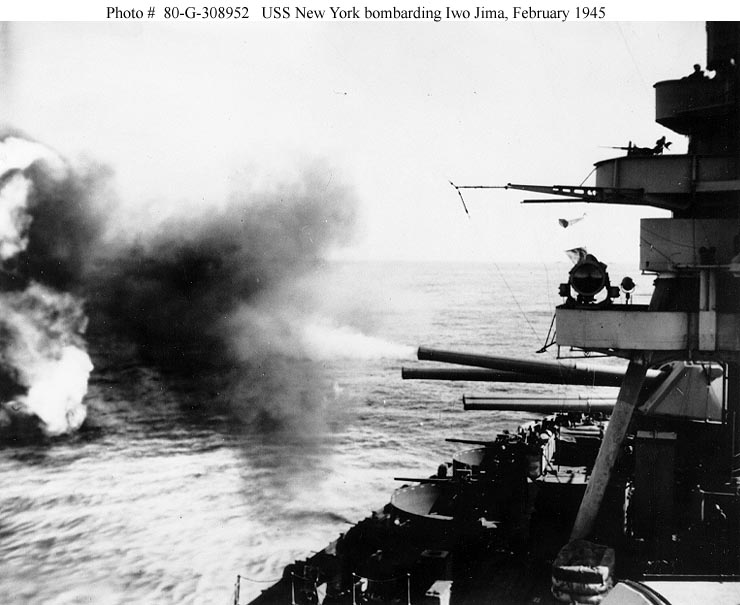
of the main body to join in preinvasion bombardment at Iwo Jima 16 February.
During the next 3 days, New York's big guns were active bombarding Iwo Jima
before and during the Marines' assault on that island, firing more rounds than any other ship present; and,
as if to show what an old-timer could do, made a spectacular direct 14"-hit on
an enemy ammunition dump.
Leaving Iwo Jima, New York at last repaired her propellers at Manus,
and had speed restored for the assault on Okinawa, which she reached 27 March to
begin 76 consecutive days of action. She fired preinvasion and diversionary
bombardments, covered landings, and gave days and nights of close support to
troops advancing ashore. She did not go unscathed; a kamikaze grazed her 14
April 1945, demolishing her spotting plane on its catapult. She left Okinawa 11 June
to regun at Pearl Harbor.
New York prepared at Pearl Harbor for the planned invasion of Japan,
and after war's end, made a voyage to the West Coast returning veterans and
bringing out their replacements. Following the Japanese capitulation in August 1945, New York
moved back to the Atlantic and was at New York City for the Navy Day fleet
review in late October. She sailed from Pearl Harbor again 29 September
with passengers for New York, arriving 19 October. Here she prepared to
serve as target ship in operation "Crossroads," the Bikini atomic tests, sailing
4 March 1946 for the West Coast. She left San Francisco 1 May, and after calls
in Pearl Harbor and Kwajalein, reached Bikini 15 June.
Her last active service was as a target during the atomic bomb tests at
Bikini, Marshall Islands, in July 1946. Surviving the surface
blast 1 July and the underwater explosion 25 July, she was taken into Kwajalein
and decommissioned there 29 August 1946. Later towed to Pearl Harbor, she was
studied during the next two years. Too radioactive and far too old for further
use, she decommissioned a month later. On 8 July 1948 she was towed out to sea some
40 miles and there sunk after an 8-hour pounding by ships and planes carrying
out full-scale battle maneuvers with new weapons.
New York received 3 battle stars for World War II service.




Click Link to View Additional USS New York Photographs
Early History
World War II
Final Days
Return to
USS New York Index